|
 At the beginning of the route along
which visitors are guided, which passes through a series of large,
well-lit rooms, the first work encountered is the bust of Francesco
I by Bernini, which virtually sets the Este seal on the entire
Gallery. The collection of pictures transferred here from the
Palazzo Ducale consists of the most important paintings collected
by the Este dukes. It is a large collection, with works by the
Emilian and Tuscan primitives, by the XV Century painters of the
Po Plain (particularly Cosmè Tura) and by Modena
artists of the XIV and XV Century (from the lovely portable altar
piece by Tommaso da Modena to the Polittico degli Erri).
The passage to the Renaissance period is underlined in a room
of bronze busts in strictly classical style, and display cases
of bonzes and ivories. J. Bassano is well represented amongst
the painters of the Veneto area, while there are also works by
Flemish, German and French artists. At the end of the first large
corridor, in rooms housing works of different periods and by artists
of different origins, there is a section dedicated to sculpture.
Here there are works by two great Modena artists in this genre:
G. Mazzoni (XV Century), with an expressive, realistic
Head of an Old Man in polychrome, and A. Begarelli (XVI
Century), with a large group of the Madonna and Child and
a number of smaller works also on sacred themes. For a number
of rooms paintings alternate with other works of art: the Este
Harp, a musical instrument with rare technical features, marble
busts of Este dukes (Ercole II and Alfonso I), and display
cases of ivories, majolicas, glassware and bronzes. Also important
are a splendid portable altar-piece by El Greco
and the Gonzaga Vase by P.J. Bonaccolsi, known as
l'Antico. The collection also features valuable items intended
for everyday use, including a travelling writing-desk in inlaid
wood and a cabinet decorate with amber and ivory figures. A series
of medallions include one of Leonello d'Este by Pisanello.
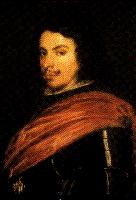
Amongst the faces of so many illustrious personalities there
is also the most famous piece in the collection, the portrait
of Francesco I by Velazquez, which was returned to the
gallery in 1995 after it had been stolen in an armed robbery in
1992, together with other works of quality, including the Madonna
Campori by Correggio and a Venetian scene by Guardi.
One room is dominated by the Venetian painters, above all Palma
il Giovane, Tintoretto and Veronese, with a
splendid S. Menna. This is followed by a long series
of altar-pieces, including the Crucifixion and S. Rocco
in prison by G. Reni and a Martyrdom of St
Peter by Guercino. The next room also contains two
works by Guercino, one of them the famous Venus, Mars
and Cupid. The last room contains works by artists of
the school of Caravaggio of the XVII Century and two landscapes
by Salvator Rosa.
At the beginning of the route along
which visitors are guided, which passes through a series of large,
well-lit rooms, the first work encountered is the bust of Francesco
I by Bernini, which virtually sets the Este seal on the entire
Gallery. The collection of pictures transferred here from the
Palazzo Ducale consists of the most important paintings collected
by the Este dukes. It is a large collection, with works by the
Emilian and Tuscan primitives, by the XV Century painters of the
Po Plain (particularly Cosmè Tura) and by Modena
artists of the XIV and XV Century (from the lovely portable altar
piece by Tommaso da Modena to the Polittico degli Erri).
The passage to the Renaissance period is underlined in a room
of bronze busts in strictly classical style, and display cases
of bonzes and ivories. J. Bassano is well represented amongst
the painters of the Veneto area, while there are also works by
Flemish, German and French artists. At the end of the first large
corridor, in rooms housing works of different periods and by artists
of different origins, there is a section dedicated to sculpture.
Here there are works by two great Modena artists in this genre:
G. Mazzoni (XV Century), with an expressive, realistic
Head of an Old Man in polychrome, and A. Begarelli (XVI
Century), with a large group of the Madonna and Child and
a number of smaller works also on sacred themes. For a number
of rooms paintings alternate with other works of art: the Este
Harp, a musical instrument with rare technical features, marble
busts of Este dukes (Ercole II and Alfonso I), and display
cases of ivories, majolicas, glassware and bronzes. Also important
are a splendid portable altar-piece by El Greco
and the Gonzaga Vase by P.J. Bonaccolsi, known as
l'Antico. The collection also features valuable items intended
for everyday use, including a travelling writing-desk in inlaid
wood and a cabinet decorate with amber and ivory figures. A series
of medallions include one of Leonello d'Este by Pisanello.
Amongst the faces of so many illustrious personalities there
is also the most famous piece in the collection, the portrait
of Francesco I by Velazquez, which was returned to the
gallery in 1995 after it had been stolen in an armed robbery in
1992, together with other works of quality, including the Madonna
Campori by Correggio and a Venetian scene by Guardi.
One room is dominated by the Venetian painters, above all Palma
il Giovane, Tintoretto and Veronese, with a
splendid S. Menna. This is followed by a long series
of altar-pieces, including the Crucifixion and S. Rocco
in prison by G. Reni and a Martyrdom of St
Peter by Guercino. The next room also contains two
works by Guercino, one of them the famous Venus, Mars
and Cupid. The last room contains works by artists of
the school of Caravaggio of the XVII Century and two landscapes
by Salvator Rosa.
|



