|
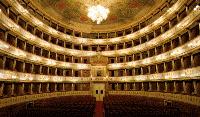 The Teatro Comunale stands in
the centre of the city, in corso Canalgrande, a street lined on
both sides with mainly XVIII Century buildings which can justly
claim to be one of Modena's most attractive thoroughfares. On
evenings when performances are to take place, the building is
lit up so that it stands out clearly as a focal point in the city's
cultural life. Designed by Vandelli, the architect of the Este
dukes, the theatre was opened in 1841. Its facade features a
large arcade topped by a balustrade on marble columns. The moulded
decorations on the outside, by L. Righi, pay homage to artistic
activities in the Modena area; the pediment displays the Presiding
Genius of Modena, holding a torch and resting his other hand on
the city's coat of arms. The theatre, which seats 1200, offers
seasons of opera, classical music and ballet running from October
to May. Modena's play-goers are served by the Teatro Storchi,
the city's other XIX Century theatre, built between 1885 and 1888
to the design of the architect V. Maestri. It stands a few hundred
metres from the Teatro Comunale, on the piazza now known as Largo
Garibaldi, overlooking the fountain by Graziosi portraying the
Secchia and Panaro rivers. After radical renovation, the Teatro
Storchi has become a prestige cultural centre of equal importance
with the Teatro Comunale. In 1991 it became the base for ERT
(Emilia Romagna Teatro), one of Italy's fourteen permanent theatre
companies. The different uses of the two public theatres make
it possible to offer a wider range of types of entertainment and
have also given opera fans a specific venue for enjoying the "bel
canto" tradition which has produced the tenor Luciano Pavarotti
and the soprano Mirella Freni, both singers of world renown.
Another famous soprano, Raina Kabaivanska, has also been resident
in Modena for some time.
The Teatro Comunale stands in
the centre of the city, in corso Canalgrande, a street lined on
both sides with mainly XVIII Century buildings which can justly
claim to be one of Modena's most attractive thoroughfares. On
evenings when performances are to take place, the building is
lit up so that it stands out clearly as a focal point in the city's
cultural life. Designed by Vandelli, the architect of the Este
dukes, the theatre was opened in 1841. Its facade features a
large arcade topped by a balustrade on marble columns. The moulded
decorations on the outside, by L. Righi, pay homage to artistic
activities in the Modena area; the pediment displays the Presiding
Genius of Modena, holding a torch and resting his other hand on
the city's coat of arms. The theatre, which seats 1200, offers
seasons of opera, classical music and ballet running from October
to May. Modena's play-goers are served by the Teatro Storchi,
the city's other XIX Century theatre, built between 1885 and 1888
to the design of the architect V. Maestri. It stands a few hundred
metres from the Teatro Comunale, on the piazza now known as Largo
Garibaldi, overlooking the fountain by Graziosi portraying the
Secchia and Panaro rivers. After radical renovation, the Teatro
Storchi has become a prestige cultural centre of equal importance
with the Teatro Comunale. In 1991 it became the base for ERT
(Emilia Romagna Teatro), one of Italy's fourteen permanent theatre
companies. The different uses of the two public theatres make
it possible to offer a wider range of types of entertainment and
have also given opera fans a specific venue for enjoying the "bel
canto" tradition which has produced the tenor Luciano Pavarotti
and the soprano Mirella Freni, both singers of world renown.
Another famous soprano, Raina Kabaivanska, has also been resident
in Modena for some time.
|



