
|
Flour, the traditional staple |
|
|
|

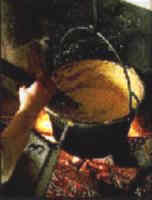
Many traditional recipes were developed
by poor people who had only the few basic ingredients produced
in a closed agricultural economy that was self-sufficient by necessity.
They have survived in the local tradition, and have now been
rediscovered in numerous trattorias in the countryside and in
the mountains, as part of the search for genuineness noticeable
in eating habits since the 1960s. The flour-based recipes of
the different areas of the province vary quite distinctly; in
the richer areas of the plain, fat is used in the cooking method,
while in the mountains where life was a hard struggle against
poverty, no fat is used.
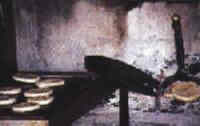
This original method has now been replaced by moulds consisting of two cast iron plates, each with cavities for six or more tigella muffins, which fit together and can be placed on the gas burner of a modern kitchen hob. Tigella muffins are usually cut in half and filled with sliced cured meats or with a special mixture of minced pork fat, rosemary, garlic and parmesan cheese. Polenta, or maize porridge, served with mushroom sauce, cheeses or a meat ragout, or cut into slices and fried to accompany other dishes, is another traditional food common in all areas of Modena's Apennines. Borlenghi are only found in a more limited area around the Panaro valley. They are a kind of thin pancake, flavoured with garlic and seasoned with parmesan cheese, produced by cooking a semi-liquid mixture of water and flour on a steel plate. One of the most distinctive mountain specialities is ciacci, made from chestnut flour. A very liquid mixture of flour and water is cooked on a steel plate to produce a thin disk which is filled with local ricotta cottage cheese and sugar and rolled. Castagnaccio is also made from chestnut flower; it is an oven-baked cake, flavoured with lemon rind and these days also with cocoa powder. |
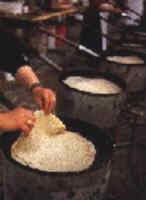 Gnocco fritto is made from flour,
salt and water fried in lard from home-fattened pigs. The dough
is rolled out into a sheet somewhat thicker than an egg pasta
and then cut into small diamond shapes which are tossed into the
boiling melted lard, where they swell and become crisp, ready
for eating with any of the local charcuterie products, or grapes
when in season. The equivalent in the hill and mountain areas
is known as tigella or crescenta. The dough is
very similar to that for gnocco fritto, but the cooking method
could not be more different, as the small pieces of dough are
crushed between two flat, clean stones or pottery moulds (often
decorated with the typical rose or six-pointed star motif) which
are then placed in the hot embers of a fire.
Gnocco fritto is made from flour,
salt and water fried in lard from home-fattened pigs. The dough
is rolled out into a sheet somewhat thicker than an egg pasta
and then cut into small diamond shapes which are tossed into the
boiling melted lard, where they swell and become crisp, ready
for eating with any of the local charcuterie products, or grapes
when in season. The equivalent in the hill and mountain areas
is known as tigella or crescenta. The dough is
very similar to that for gnocco fritto, but the cooking method
could not be more different, as the small pieces of dough are
crushed between two flat, clean stones or pottery moulds (often
decorated with the typical rose or six-pointed star motif) which
are then placed in the hot embers of a fire.
|
|
|
|
© 1997 - Provincia di Modena - Made by
|

|
